
Just Recovery in WNC? Reflections on Helene & Beyond
As we gathered with our eight regional Resiliency Organizing Hubs last week, we reflected on the second anniversary of Hurricane Helene and the other climate disasters which have continued to deeply impact every region of our state. Our hearts are with our WNC mountain communities who continue to struggle for adequate state and federal funding, and with our coastal communities – especially those on the Outer Banks – who will need ongoing support to recover from this week’s nor’easter flooding made worse by sea level rise.
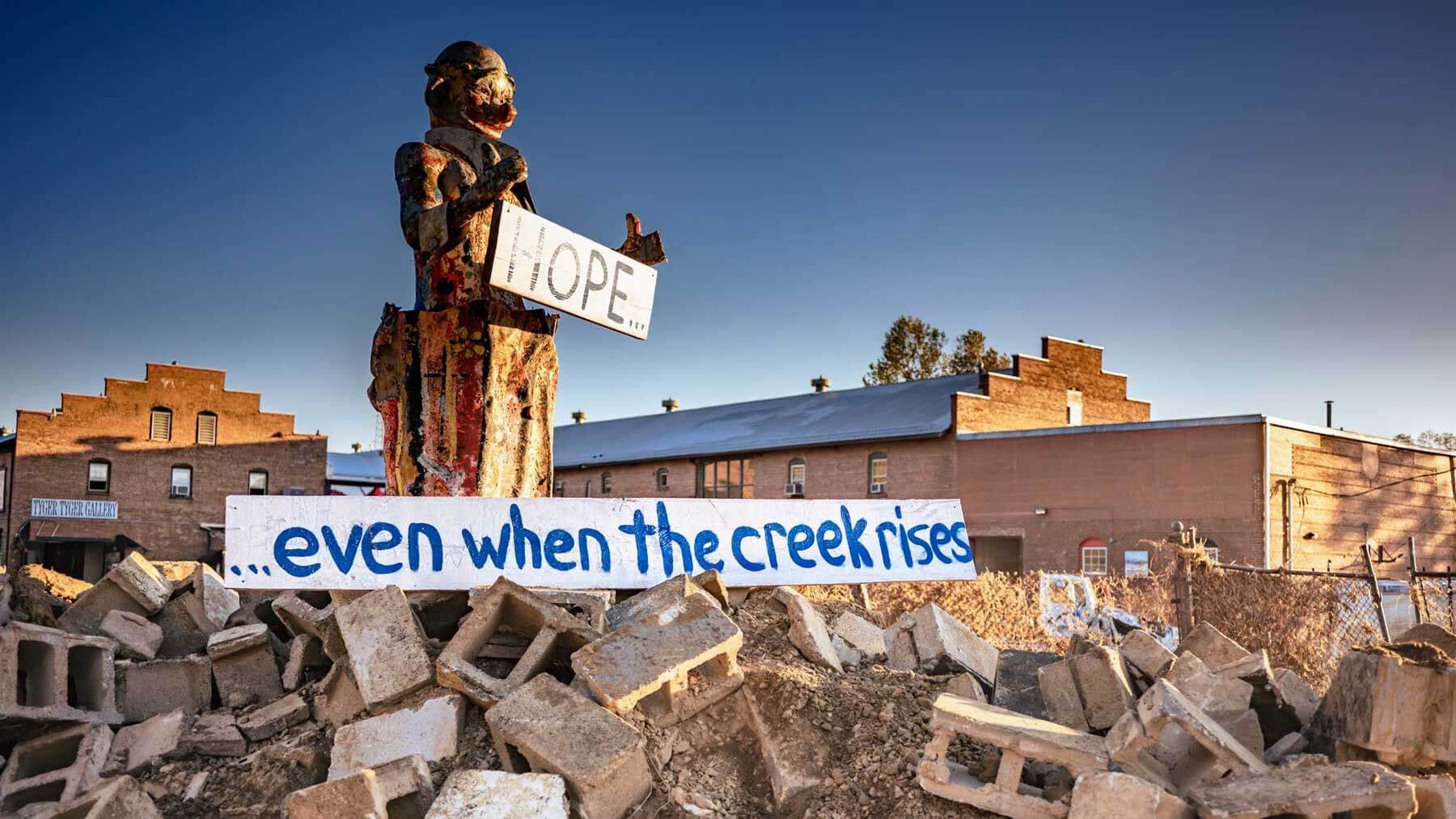
A statue erected in Asheville's River Arts District commemorates Hurricane Helene, with signage that reads: "Hope... even when the creek rises." (Photo credit: Michael Freas Photography via Artsville USA)
NCCJC’s resiliency organizing across our state is shaped by our understanding of Just Recovery. The Just Recovery framework has been a pillar of NCCJC’s work since our friend and Gulf South organizer, Jayeesha Dutta, created the framework and supported us to establish the Just Florence Recovery initiative in eastern NC in September 2018.
For us, the Just Recovery framework is both a compass and a map. When we get lost in the nasty fog of disaster capitalism, we know these key indicators can help us course correct:
First, a Just Recovery is underway if the marginalized people who were first and worst impacted are at the center of envisioning, decision-making, and resource allocation for every step of the recovery to rebuild process.
Second, Just Recovery is happening if we can point to systems-level change in how rebuilding torwards a Just Transition.
What do we mean by Just Recovery?
The commitment to a Just Recovery disrupts the “status quo” framework – where disaster response is largely driven by large, outside groups and often leads to extraction and displacement.
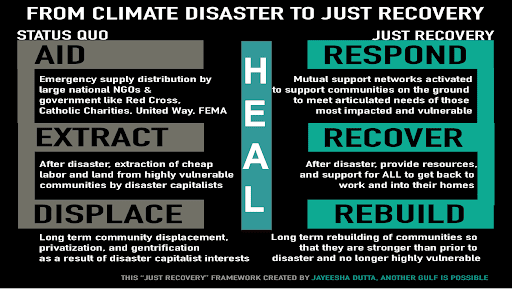
This graphic details the Just Recovery framework, which aims to disrupt the historic patterns of disaster response. (Image credit: Jayeesha Dutta, Another Gulf Is Possible)
So, is it or isn’t it a Just Recovery? Consider these questions:
RESPOND: Are people being served (charity)? Or are they driving the response (reciprocal solidarity)?
Community-led networks are activated to meet the needs of the most vulnerable.
Resources flow based on the self-identified needs of those most impacted and vulnerable.
The most-impacted and vulnerable people are shaping the response and making the decisions.
RECOVER: Is value being taken out of the community or circulated within it? Will these resources cause harm?
Resources support everyone’s return to stability in an equitable way, prioritizing the most vulnerable and marginalized.
Investment prioritizes the most impacted and traditionally underserved.
Resources stay local and support community recovery for those who need the most support.
Investments in health & healing, therapy, community mediation ensure the well-being of all.
REBUILD: Who can come back, and who is permanently pushed out?
Marginalized and most impacted community members return and stay.
Community is stronger, safer, less vulnerable than before – in a way that is self-determined.
Long-term resilience is built, relationships and health of individuals and networks are strong.
Investments support climate solutions and systems change so that a Just Transition to a regenerative localized economy is well underway.
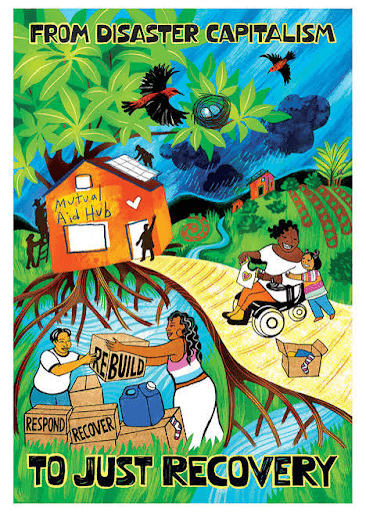
This graphic, “From Disaster Capitalism to Just Recovery,” was created by Micah Bazant for the
Regenerative Economy Poster Portfolio, a project of Climate Justice Alliance’s Creative Wildfire project.
The Role of Art & Culture
Arts and culture are also integral parts of a truly Just Recovery. NCCJC and our partners recognize that artists are often first responders – people are connected to a broad, diverse swatch of the community and have community spaces that can be activated.
Artists and cultural workers also support inner resilience, care and healing. As Jayeesha notes in her reflections on Just Recovery:
“Because oppression is persistent, healing must be persistent. Healing cannot wait until the oppressive structures acquiesce, are dismantled, or come undone. We cannot heal society if we do not heal the human spirit.”
We need to value and resource community-accountable artists as part of our Just Recovery work!
What does Just Recovery look like for western NC?
It looks like the work that our Resiliency Organizing Hub anchor in Asheville, Hood Huggers International, has been leading for over a decade of partnership with NCCJC.
Hood Huggers Co-Founder and Executive Director, DeWayne Barton shared reflections on the two-year anniversary of Helene and mixed progress toward a Just Recovery at our recent Hub retreat in Kinston:
“There's a lot of building going on, and we want to be sure that the people who live here, especially the young people, are part of the growth that's happening in and around the city. A lot of the policies that were in place prior to Hurricane Helene and to this current administration, around the environment and equity and inclusion [have been rolled back].There's so much need and also so much opportunity."
- Dewayne Barton, Hood Huggers International & Resiliency Organizing Hub Leader
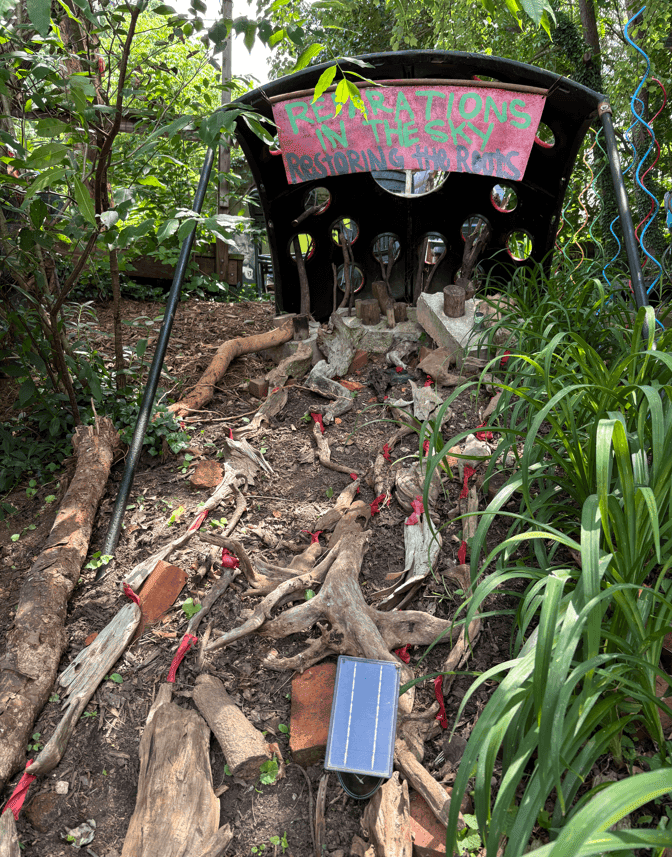
Hood Huggers' Peace Garden houses art installations focused on the intersection of racial and climate justice. This piece reads, "Reparations in the sky; Restoring the roots." (Photo credit: Jodi Lasseter)
NCCJC’s Resiliency Organizing Fellow, Dulce Mirian Porras, has been organizing for a Just Recovery since Hurricane Helene hit WNC. She is one of the co-leaders of the Just Recovery and Healing Collaborative, which works to ensure that historically marginalized communities and grassroots groups are fully included in the regional planning and rebuilding effort. They have expanded their membership to include more BIPOC community based groups and staff from several municipalities across Buncombe County. They are focusing on affordable housing and food justice, including an urban garden network.
Dulce also shared her reflections on the anniversary at last week's Hub retreat in Kinston:
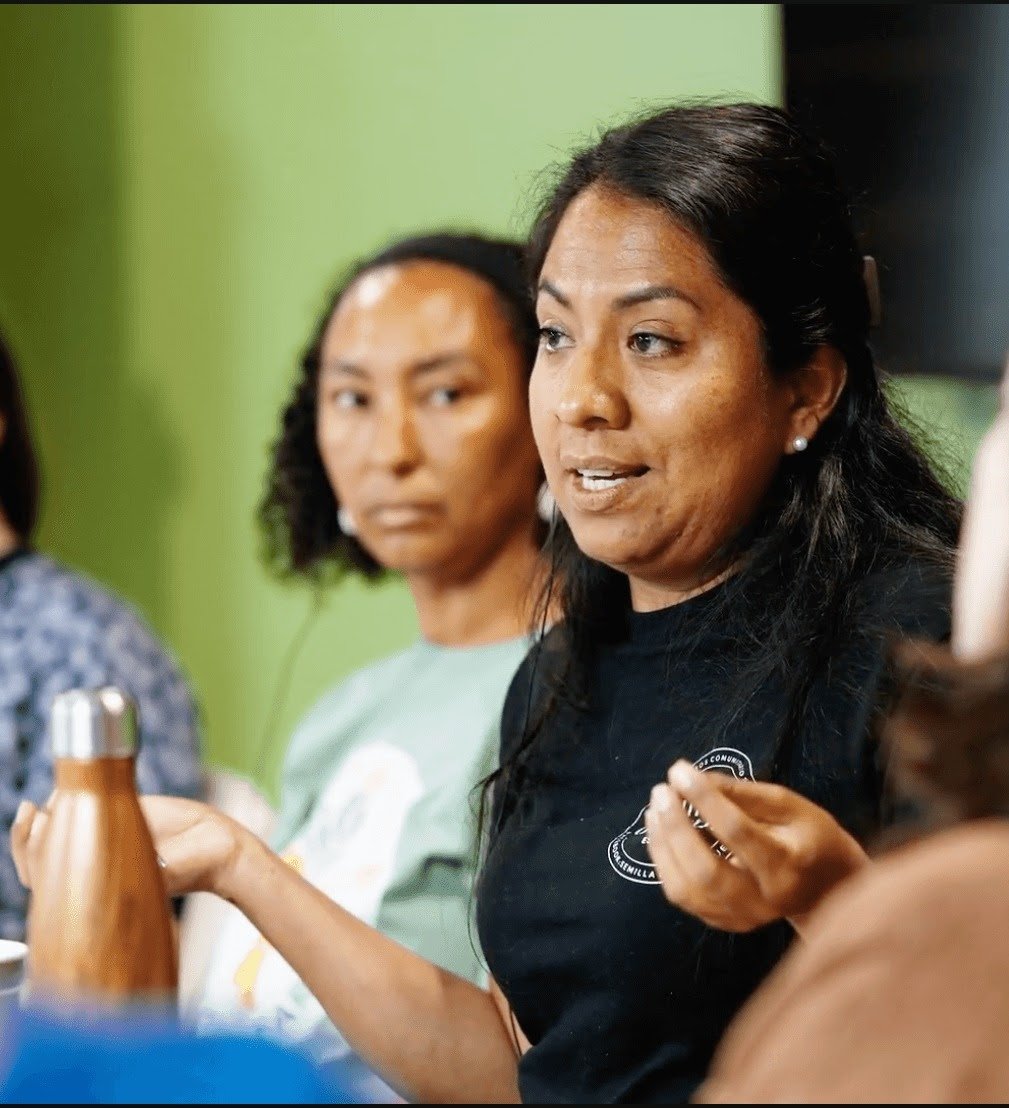
"I feel proud of how our communities pulled together to respond to the emergency and in solidarity with everyone who was impacted. Together, we built the Just Recovery and Healing Collaborative... and have been working for the past 2 years to make sure that we support each other... and bring resources for BIPOC communities. I am very called to keep working towards the Just Recovery and to keep gathering our people together to be prepared in case of any future disaster, and to be restoring and rethinking a better world.”
- Dulce Mirian Porras (NCCJC Resiliency Organizing Fellow with Hood Huggers International)
This spring, as part of our ongoing work, NCCJC offered a training session with the Just Recovery and Healing Collaborative (video credit: Jamaal Torrance) and a day-long workshop, Re-Creating Swannanoa through Just Recovery in partnership with Warren Wilson College and over a dozen community based groups.
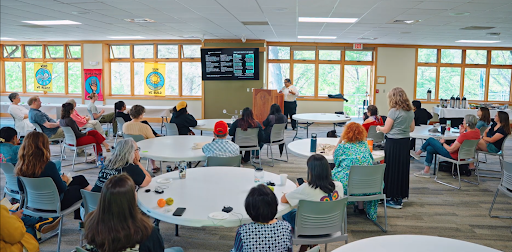
Longtime friend of NCCJC, Jayeesha Dutta, presents on the Just Recovery framework she developed at a recent workshop in Swannanoa, NC. (Image credit: Jamaal Torrance)
As part of the workshop, the group outlined values to build trust and continue guiding their community-led Just Recovery efforts:
Transparency
Commitment to closing the gap in participation of vulnerable communities in planning and decision-making
Commitment to bring resources to vulnerable communities to sustain their leadership in ongoing recovery work
Acknowledge and respect the privacy of all impacted community members with prior consent to record or share their stories & images
So while we haven’t achieved a full Just Recovery in any of our disaster impacted communities in NC, we know that having a clear vision and process to get there makes it possible!
If you're based in western NC or another climate-impacted community and are interested in learning more about the Just Recovery and Healing Collaborative, please reach out.
